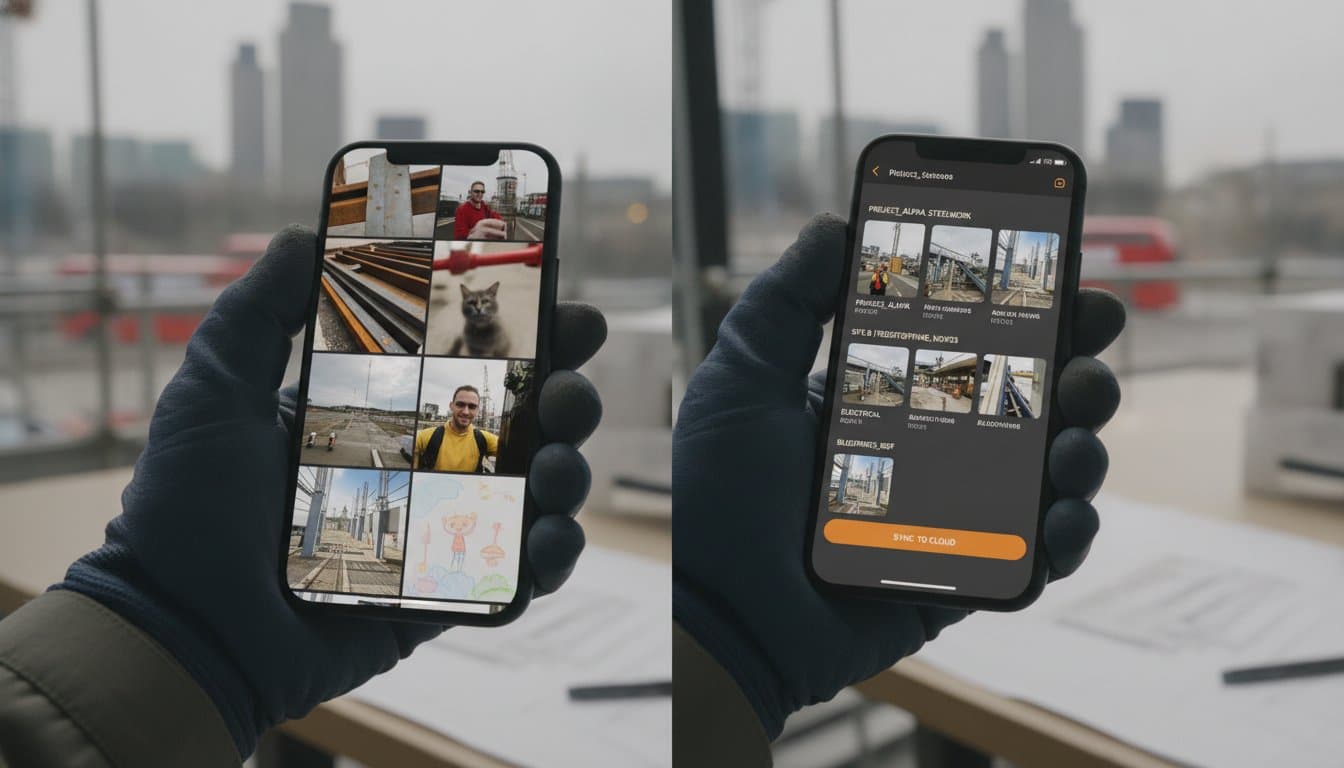
You’re standing on site, trying to prove a fire barrier was installed correctly three months ago. The subcontractor who did the work is long gone. The photos you need are trapped on his personal phone, buried between pictures of his dog and last Sunday’s roast. This is the reality for many trying to maintain Golden Thread photo records for construction. It’s messy, it’s slow, and it’s a risk you don’t need.
We know the feeling of chasing evidence for handover months after the work is finished. It shouldn't feel like a second job. This guide will show you how to capture and organise reliable records that meet every requirement without adding hours of admin to your week. You’ll learn how to keep your work photos separate from your personal life while keeping them ready for the people who need them.
We will look at why your personal camera roll is the enemy of a clear conscience at handover. You'll discover how to build a searchable library of every structural pour or fire stop, ensuring you have instant proof for regulators. If the photo matters later, it needs to be organised when it is taken.
Key Takeaways
- Learn why relying on a personal camera roll puts your handover at risk when photos are buried amongst personal images.
- Discover why the secret to Golden Thread photo records for construction is organising evidence in the field rather than back at your desk.
- Understand the three essential pieces of context every work photo needs to stay searchable and reliable for your team.
- See how selecting a Photo Type before you capture an image ensures your records are shared and sorted from the second they are taken.
- Find out how to keep your professional site images completely separate from your personal photos without adding hours of admin to your workday.
The Golden Thread challenge: Why your camera roll fails construction compliance
Imagine a regulator walks onto your site. They ask for proof of a fire-stopping installation from six months ago. You know the photo was taken. You saw it on the supervisor’s screen at the time. But that supervisor left the company last month. Now, that vital piece of evidence is buried amongst thousands of personal holiday photos on a phone you no longer have access to. It is gone.
This is the "broken thread". It is where evidence is captured but cannot be found or shared when it actually matters. Building Golden Thread photo records for construction isn't just about taking pictures. It’s about ensuring that information is reliable, accurate, and accessible for the entire life of the building. Under the Building Safety Act 2022, having "lost" photos isn't just an admin headache; it is a compliance failure that carries real weight.
The risk of personal phones on site
Mixing work photos with family holidays makes professional search impossible. Your camera roll becomes a mess of site debris and Sunday roasts. Beyond the clutter, there is a real business risk. When staff leave the business, your records often leave with them. Storing sensitive project data on personal cloud accounts also creates massive privacy concerns. You wouldn't store company contracts in a personal scrapbook; work photos should be no different.
Why WhatsApp and group chats are not the answer
Group chats feel fast, but they are a trap for long-term records. WhatsApp and similar apps often compress images. This strips away the vital detail and metadata needed for true accountability. Searching through months of messages and "thumbs up" emojis to find one specific concrete pour is a massive time drain. It is exactly why your personal camera roll is the wrong place for work. If you cannot find the photo in ten seconds, it might as well not exist.

Building a reliable audit trail: How to organise photos at the point of capture
It's Friday afternoon. You’re sat at your desk with a coffee. You're trying to remember which fire collar was installed on the fourth floor. Was it Tuesday or Wednesday? The secret to Golden Thread photo records for construction isn't better sorting at your desk. It’s better capture in the field. If you wait until the end of the week to label your work photos, you’ve already lost the thread.
Details fade. Labels get mixed up. By the time you’re typing up a report, the work is often already covered by plasterboard. Professional teams use a "capture first" mindset. They record the evidence before it disappears. This ensures the digital record of information is accurate from the second the shutter clicks.
The 'what, where, who' rule for work records
Every work photo needs three pieces of context: what it is, where it is, and who took it. Don't just snap and pray. Identify the Photo Type before you hit the shutter. Is it a pre-cover check? An inspection? A delivery? Selecting the category first means the photo organises itself. It eliminates the end-of-week admin backlog because the work is already filed before you leave the site. You can start capturing better records today to see the difference in your daily workflow.
Creating a shared library for the whole team
Stop letting photos rot in individual silos. When every subcontractor has their own way of saving images, the main contractor has no visibility. Centralising photos in a dedicated work library changes the game. It enables real-time progress checks without constant site visits. You can see what’s happening in seconds. This is how you maintain Golden Thread photo records for construction across multiple teams. It is the most effective way to build a work photo library that protects your retention and keeps the project moving. Shared access means no more chasing evidence months after the job is finished.
The professional work camera: Making Golden Thread records a natural part of the day
Using a standard camera app for professional work is like using a kitchen knife to dig a trench. It might work, but it’s the wrong tool for the job. A specialised work camera app like Thanex changes the workflow entirely. It keeps your professional life separate from your personal gallery. No more scrolling past family photos to find a site inspection. No more clutter.
The process is simple. You manually select the Photo Type before you capture the image. This ensures the photo is organised from second one. Because photos are stored in secure cloud storage rather than on your local device, your business data stays protected. Even if a phone is lost or an employee leaves, your Golden Thread photo records for construction remain safe and accessible in the cloud. It is about keeping control of your information.
Finding what you need shouldn't take all morning. Searchable libraries allow you to find "fire barrier" or "Plot 4" in seconds. By using AI-assisted retrieval, you can pull up specific evidence without digging through messy folders. It turns a mountain of images into a usable asset. You get the answers you need, exactly when you need them.
Instant retrieval for handover and inspections
Handover day should be a celebration, not a scramble. Instead of uploading thousands of loose files to shared drives, you can generate shareable evidence report links. These links provide instant proof of work quality to clients and regulators. It is a professional way to deliver an immutable audit trail for construction photos. Stop wasting time on uploads and start sending instant, organised links.
A simple takeaway for site teams
Work photos should not become another job after the work is done. If the photo matters later, it needs to be organised when it is taken. Keep it simple: capture, categorise, and carry on with the build. This approach ensures your Golden Thread photo records for construction are always ready without adding hours of admin to your workday. If you want to see how it works, visit thanex.uk.
Take control of your site evidence
The days of chasing subcontractors for photos or scrolling through personal galleries are over. You now know that the secret to Golden Thread photo records for construction isn't better filing. It's better capture. By choosing the Photo Type before you snap, you ensure the record is ready for handover before you even leave the plot.
Professionals in electrical, plumbing, and maintenance are already using Thanex to keep their work separate. Your photos are stored in the Thanex cloud, not your camera roll. This keeps your personal life private and your business data secure. With an AI-queryable library for instant retrieval, you'll never waste another morning looking for a fire barrier photo from six months ago.
It’s time to stop the end-of-week admin battle. You can start organising your Golden Thread records with Thanex today and get back to the actual build. Work photos should not become another job after the work is done. You've got this.
Frequently Asked Questions
What exactly is the Golden Thread in UK construction?
The Golden Thread is a digital record of information that documents a building's safety throughout its entire lifecycle. Introduced by the Building Safety Act 2022, it ensures that high-risk buildings are safe for residents from design through to occupation. This information must be accurate, up-to-date, and easily accessible. It acts as a single source of truth, showing exactly how a building was designed, built, and managed over time.
Is it legal to store Golden Thread photo records on a personal phone?
While there isn't a law specifically banning personal devices, using a personal camera roll for Golden Thread photo records for construction is a massive risk. Regulatory requirements state that records must be secure and accessible at all times. Photos trapped on a former employee’s device are neither. If you can’t produce evidence when a regulator asks, you aren't meeting the legal standard for a reliable digital record.
How long should I keep construction photo records for compliance?
You should plan to keep your work photos for at least 15 to 30 years. The Building Safety Act 2022 significantly extended the liability periods for defective work. This means you could be asked for proof of a specific installation decades after the project finishes. Storing these in a professional cloud library ensures they don't get lost when you upgrade your phone or change your team.
What is the best way to share site photos with a Building Safety Regulator?
The best way to share photos is through a shareable, organised link rather than messy email attachments or physical drives. Regulators need to see that your evidence is structured and reliable. Sending a link to a specific project or Photo Type shows you have a professional system in place. It allows them to find exactly what they need in seconds without wading through thousands of irrelevant site images.
Disclaimer
The Thanex team writes about work photos, photo organisation, and the problem of finding important photos later.
Our experience started in construction, where clear photo records and traceability matter every day. But the problem is wider than one industry.
These guides are written to be practical, honest, and focused on real work.
Frequently Asked Questions
The risk of personal phones on site
Mixing work photos with family holidays makes professional search impossible. Your camera roll becomes a mess of site debris and Sunday roasts. Beyond the clutter, there is a real business risk. When staff leave the business, your records often leave with them. Storing sensitive project data on personal cloud accounts also creates massive privacy concerns. You wouldn't store company contracts in a personal scrapbook; work photos should be no different.
Why WhatsApp and group chats are not the answer
Group chats feel fast, but they are a trap for long-term records. WhatsApp and similar apps often compress images. This strips away the vital detail and metadata needed for true accountability. Searching through months of messages and "thumbs up" emojis to find one specific concrete pour is a massive time drain. It is exactly why your personal camera roll is the wrong place for work. If you cannot find the photo in ten seconds, it might as well not exist. It's Friday afternoon. You’re sat at your desk with a coffee. You're trying to remember which fire collar was installed on the fourth floor. Was it Tuesday or Wednesday? The secret to Golden Thread photo records for construction isn't better sorting at your desk. It’s better capture in the field. If you wait until the end of the week to label your work photos, you’ve already lost the thread. Details fade. Labels get mixed up. By the time you’re typing up a report, the work is often already covered by plasterboard. Professional teams use a "capture first" mindset. They record the evidence before it disappears. This ensures the digital record of information is accurate from the second the shutter clicks.
The 'what, where, who' rule for work records
Every work photo needs three pieces of context: what it is, where it is, and who took it. Don't just snap and pray. Identify the Photo Type before you hit the shutter. Is it a pre-cover check? An inspection? A delivery? Selecting the category first means the photo organises itself. It eliminates the end-of-week admin backlog because the work is already filed before you leave the site. You can start capturing better records today to see the difference in your daily workflow.
Creating a shared library for the whole team
Stop letting photos rot in individual silos. When every subcontractor has their own way of saving images, the main contractor has no visibility. Centralising photos in a dedicated work library changes the game. It enables real-time progress checks without constant site visits. You can see what’s happening in seconds. This is how you maintain Golden Thread photo records for construction across multiple teams. It is the most effective way to build a work photo library that protects your retention and keeps the project moving. Shared access means no more chasing evidence months after the job is finished. Using a standard camera app for professional work is like using a kitchen knife to dig a trench. It might work, but it’s the wrong tool for the job. A specialised work camera app like Thanex changes the workflow entirely. It keeps your professional life separate from your personal gallery. No more scrolling past family photos to find a site inspection. No more clutter. The process is simple. You manually select the Photo Type before you capture the image. This ensures the photo is organised from second one. Because photos are stored in secure cloud storage rather than on your local device, your business data stays protected. Even if a phone is lost or an employee leaves, your Golden Thread photo records for construction remain safe and accessible in the cloud. It is about keeping control of your information. Finding what you need shouldn't take all morning. Searchable libraries allow you to find "fire barrier" or "Plot 4" in seconds. By using AI-assisted retrieval, you can pull up specific evidence without digging through messy folders. It turns a mountain of images into a usable asset. You get the answers you need, exactly when you need them.
Instant retrieval for handover and inspections
Handover day should be a celebration, not a scramble. Instead of uploading thousands of loose files to shared drives, you can generate shareable evidence report links. These links provide instant proof of work quality to clients and regulators. It is a professional way to deliver an immutable audit trail for construction photos. Stop wasting time on uploads and start sending instant, organised links.
A simple takeaway for site teams
Work photos should not become another job after the work is done. If the photo matters later, it needs to be organised when it is taken. Keep it simple: capture, categorise, and carry on with the build. This approach ensures your Golden Thread photo records for construction are always ready without adding hours of admin to your workday. If you want to see how it works, visit thanex.uk. The days of chasing subcontractors for photos or scrolling through personal galleries are over. You now know that the secret to Golden Thread photo records for construction isn't better filing. It's better capture. By choosing the Photo Type before you snap, you ensure the record is ready for handover before you even leave the plot. Professionals in electrical, plumbing, and maintenance are already using Thanex to keep their work separate. Your photos are stored in the Thanex cloud, not your camera roll. This keeps your personal life private and your business data secure. With an AI-queryable library for instant retrieval, you'll never waste another morning looking for a fire barrier photo from six months ago. It’s time to stop the end-of-week admin battle. You can start organising your Golden Thread records with Thanex today and get back to the actual build. Work photos should not become another job after the work is done. You've got this.
What exactly is the Golden Thread in UK construction?
The Golden Thread is a digital record of information that documents a building's safety throughout its entire lifecycle. Introduced by the Building Safety Act 2022, it ensures that high-risk buildings are safe for residents from design through to occupation. This information must be accurate, up-to-date, and easily accessible. It acts as a single source of truth, showing exactly how a building was designed, built, and managed over time.
Is it legal to store Golden Thread photo records on a personal phone?
While there isn't a law specifically banning personal devices, using a personal camera roll for Golden Thread photo records for construction is a massive risk. Regulatory requirements state that records must be secure and accessible at all times. Photos trapped on a former employee’s device are neither. If you can’t produce evidence when a regulator asks, you aren't meeting the legal standard for a reliable digital record.
How long should I keep construction photo records for compliance?
You should plan to keep your work photos for at least 15 to 30 years. The Building Safety Act 2022 significantly extended the liability periods for defective work. This means you could be asked for proof of a specific installation decades after the project finishes. Storing these in a professional cloud library ensures they don't get lost when you upgrade your phone or change your team.
What is the best way to share site photos with a Building Safety Regulator?
The best way to share photos is through a shareable, organised link rather than messy email attachments or physical drives. Regulators need to see that your evidence is structured and reliable. Sending a link to a specific project or Photo Type shows you have a professional system in place. It allows them to find exactly what they need in seconds without wading through thousands of irrelevant site images.