You are standing on site on a Friday afternoon. You are scrolling through a group chat with hundreds of unread messages.
Somewhere in that digital mess is the photo of the fire-stopping before the cladding went on. If you can't find it, that variation stays unpaid. This is the cost of a disorganised work photo library.
You know the work was done. You just can't find the evidence. You lose your weekend to the search. You lose the money for the work.
It is a common frustration. You were hired to build, not to spend your evenings rebuilding QA packs from blurry screenshots sent by the lads. A professional archive should work for you. It should not be another chore.
You need a system that handles the admin so you can focus on the next job. This guide explains how to organise your site records to meet the Golden Thread requirements of the Building Safety Act 2022. You will learn how to build an archive that protects your retention and ensures every variation is backed by clear evidence. We will cover the steps to move from chaotic group chats to a searchable library that secures your profit and proves compliance.
Key Takeaways
- Learn how missing photos of cavity trays or reinforcement lead to held retention and delayed sign-off.
- Understand the Golden Thread requirements and why your records must be searchable for the Building Safety Act.
- Discover how the 'Point of Capture' rule helps you build an organised work photo library whilst the work is still visible.
- See how providing real-time visibility to main contractors builds the trust needed for faster invoice payments.
- Stop losing weekends to the lads' group chats and start using shareable evidence reports to prove your work in seconds.
The hidden cost of a disorganised work photo library
You are sitting in the van on a Friday evening. The rain is hitting the windscreen. You need one photo of a cavity tray to get the sign-off for a payment milestone. You check the group chat. It is full of banter and lunch orders. The photo is not there. You spend the next hour scrolling through thousands of messages while your dinner gets cold. This is the reality of a broken system.
This is where the money leaks out of your business. A work photo library is not just a collection of images. It is a central repository for construction evidence. It is a financial tool. If you treat it like a personal gallery, you are inviting disputes. You are allowing your profit to be questioned by clients who want any excuse to delay payment.
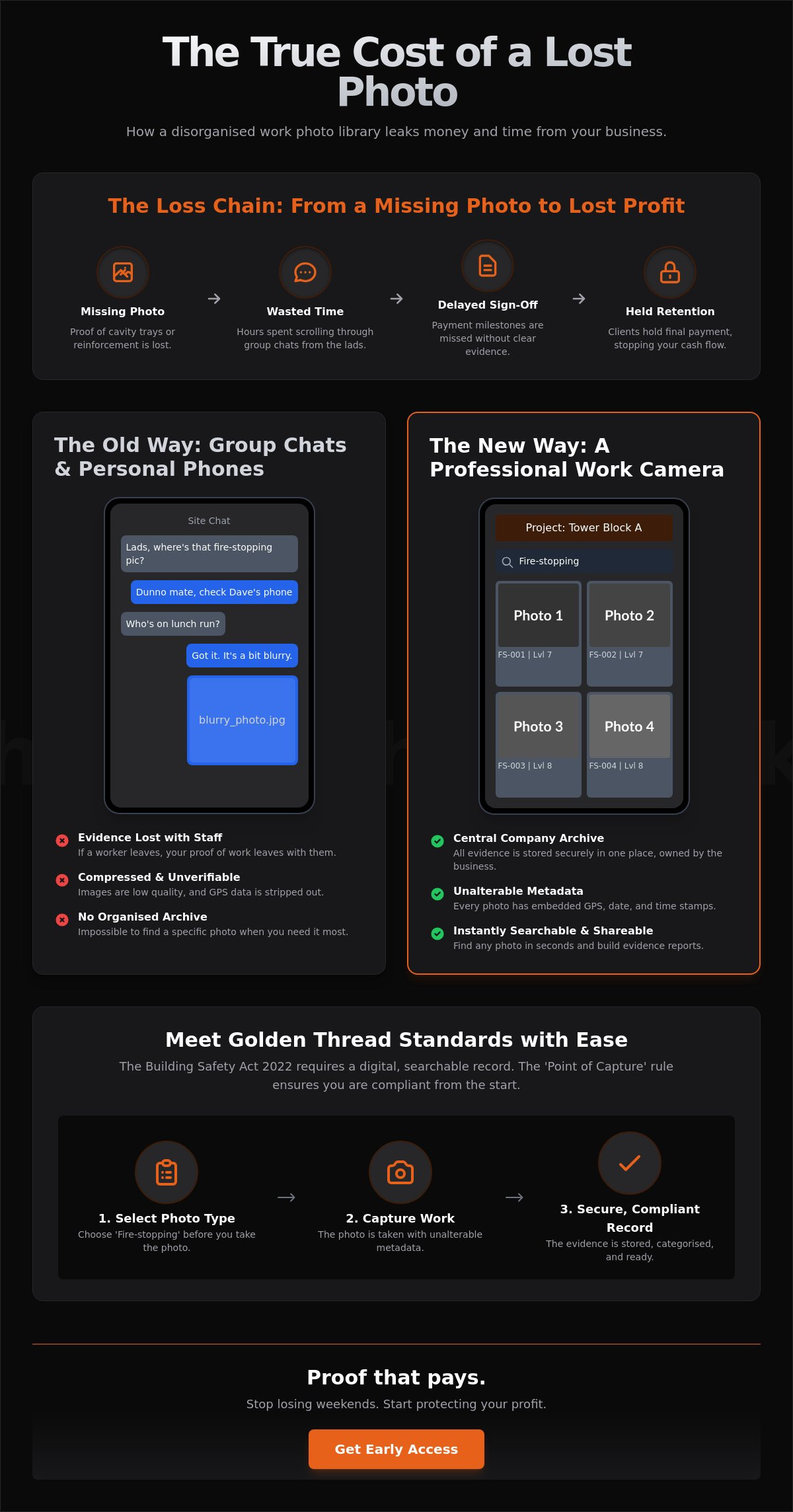
We call this "The Loss Chain." It starts with a missing photo of reinforcement or fire-stopping. Because you cannot prove the work is behind the wall, the client holds your retention. Sign-off is delayed. Your cash flow stops. You have done the work, but you cannot get the profit. You are stuck in a cycle of proving what you have already finished instead of moving to the next job.
You spend hours every week chasing the lads for handover photos. This is a massive time loss. A proper approach to Digital Asset Management in construction means having a searchable archive. Without it, you are just a site manager acting as a part-time private investigator. You are wasting your expertise on admin that should be automatic.
Why group chats and personal phones fail the lads
Personal phones are where evidence goes to die. If a worker leaves the firm, your proof leaves with them. If they drop their phone in a puddle, your QA pack is gone. You cannot build a reputation on hardware that belongs to someone else. It is a risk your business cannot afford to take.
Group chats are worse. They compress your images. You lose the metadata and the GPS timestamps you need for the Golden Thread. You are left with a blurry file that proves nothing to a surveyor. When a payment dispute hits, a disorganised work photo library on a chat app will not save you. You need a structured archive that is ready when asked. You need to capture work and prove fast.
Proof that pays.
Thanex launches soon. Get early access at thanex.uk/early-access.
How to organise site evidence for the Golden Thread
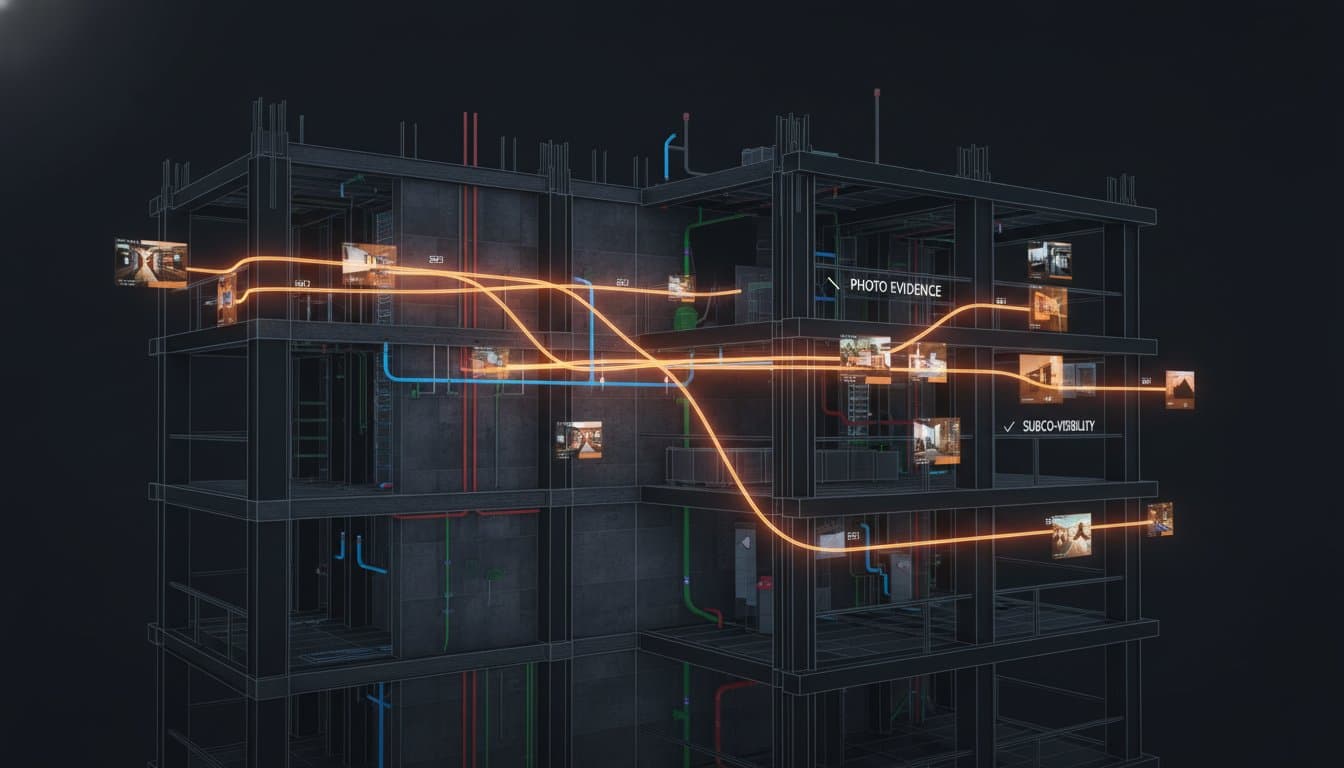
You are standing on the seventh floor of a higher-risk building. The Building Safety Regulator is asking for the digital record of the fire-stopping before the ceilings were closed. If you cannot produce a continuous, searchable record, you face a Gateway 3 failure. This means no occupation certificate. It means your final payment is blocked.
Compliance is now a legal requirement under the Building Safety Act 2022. The Golden Thread report makes it clear that information must be digital and accessible. Your work photo library cannot be a random pile of files. It must be a structured history of the build. Every image must be pinned to a specific project and job title so you have total visibility across mixed-trade teams.
To stay compliant, you must use the 'Point of Capture' rule. This means selecting the Photo Type whilst the work is still visible. You do this before the pour or the first-fix. It ensures that every photo is categorised correctly from the start. You can learn more about Golden Thread evidence and how it protects your firm from non-compliance penalties.
Capturing photos that meet Gateway 2 and 3 standards
High-risk building details require precision. When the lads are documenting fire-stopping or structural steelwork, they need to provide more than just a visual. They need unalterable metadata. GPS coordinates, dates, and time stamps act as a shield against future litigation. If a dispute arises three years later, you have the proof ready. A work camera differs from a standard camera app because it prioritises the Photo Type at the moment of capture, ensuring the data is structured before it ever hits storage.
Proof that pays.
Thanex launches soon. Get early access at thanex.uk/early-access.
Turning your site evidence into a reputation for fast payment
You are on a call with the Quantity Surveyor. They are questioning a variation for a hidden drainage run. You know the work was done. You know the cost was real. But without a photo, it is just your word against their spreadsheet. This is where the profit on the job is either won or lost.
A searchable work photo library allows you to end these arguments in seconds. You don't need to hang up and search through group chats. You find the job, select the photos, and generate a shareable evidence report link. You send it while they are still on the phone. This speed changes the dynamic of the conversation. It turns a dispute into a verified transaction.
Building trust with main contractors is about visibility. When you provide an immutable audit trail of your progress, you remove their risk. They see the proof. They pay the invoice. You can explore our construction evidence features to see how this visibility protects your cash flow.
From site admin to professional proof
Moving from scrolling and guessing to searching and proving is a professional shift. It is about the Admissibility and Use of Electronic Information in Construction Cases. If your photos lack structure, they lack weight in a dispute. An organised work photo library creates a psychological impact on your clients. They realise you are documenting every stage. They stop trying to push back on legitimate variations because they know the proof is ready.
This reliability wins you the next project. You aren't just the contractor who does the work. You are the contractor who proves the work. You protect your reputation and your retention at the same time. You stop losing money to "forgotten" extras and start getting paid for every hour the lads spend on site.
Proof that pays.
Thanex launches soon. Get early access at thanex.uk/early-access.
Secure your profit and protect your time
You have seen the high price of disorganisation. It is measured in unpaid variations, held retention, and lost weekends spent rebuilding QA packs. Your work photo library should be a financial asset, not a digital mess. By capturing evidence with immutable metadata, you build a record that meets the Building Safety Act standards and protects your business from risk.
The transition from scrolling through group chats to using an AI-queryable archive is a shift toward modern efficiency. You stop chasing the lads for photos and start proving your work in seconds. This is how you build the trust that brings repeat work and ensures you get paid for every hour spent on site. Take control of your site documentation today. You were hired to build, not to do admin.
Get early access to the work camera that proves your work fast
Proof that pays.
Thanex launches soon. Get early access at thanex.uk/early-access.
Frequently Asked Questions
Is a work photo library different from using a cloud storage folder?
A cloud folder is just a digital dumping ground. A work photo library is a professional evidence system that forces structure at the moment of capture. It attaches immutable metadata like GPS and timestamps to every image. You don't have to spend your Friday nights sorting through files because the system organises them by job and trade for you by default.
How do I ensure my site photos meet the Building Safety Act requirements?
Compliance requires a digital record that forms part of the Golden Thread. Your photos must be searchable and unalterable to satisfy Gateway 2 and 3 standards. By selecting the Photo Type before you click the shutter, you ensure every fire-stop or structural detail is categorised correctly. This creates the defensible audit trail required for higher-risk buildings and protects your firm from non-compliance penalties.
What happens if a photo is missing from my work photo library during a dispute?
Missing photos trigger the Loss Chain. If you can't prove a hidden variation, the Quantity Surveyor will likely strike it from the valuation. You lose the profit and your retention stays held. A structured work photo library makes capture a site habit for the lads, ensuring the proof is always ready before the work is covered up and forgotten.
Can I use a work photo library for snagging and defect management?
Yes. It is the fastest way to clear your snagging list and get to handover. You capture the defect, fix it, and document the result. This creates a clear before-and-after record that proves the work is complete. It removes the guesswork for the main contractor and helps you get your final sign-off without the usual admin headache or payment delays.
Proof that pays.
Thanex launches soon. Get early access at thanex.uk/early-access.
Disclaimer
The Thanex team builds a work camera for construction.
The story is the same on every job. You finished the work. Someone now wants proof. The photos are on three phones, two group chats, and a laptop you have not opened in months. The client is waiting. Payment is waiting. So your evening is gone again.
Thanex captures proof at the moment of work. Pick what the photo is. Take the photo. The details stay with it. Ready when someone asks.
The guides on this site are written by people who have been on site, completed QA forms, sent photo reports, and answered the customer asking for proof before they paid.
We write what we have lived. Construction first.
Frequently Asked Questions
Why group chats and personal phones fail the lads
Personal phones are where evidence goes to die. If a worker leaves the firm, your proof leaves with them. If they drop their phone in a puddle, your QA pack is gone. You cannot build a reputation on hardware that belongs to someone else. It is a risk your business cannot afford to take. Group chats are worse. They compress your images. You lose the metadata and the GPS timestamps you need for the Golden Thread. You are left with a blurry file that proves nothing to a surveyor. When a payment dispute hits, a disorganised work photo library on a chat app will not save you. You need a structured archive that is ready when asked. You need to capture work and prove fast. Proof that pays. Thanex launches soon. Get early access at thanex.uk/early-access. You are standing on the seventh floor of a higher-risk building. The Building Safety Regulator is asking for the digital record of the fire-stopping before the ceilings were closed. If you cannot produce a continuous, searchable record, you face a Gateway 3 failure. This means no occupation certificate. It means your final payment is blocked. Compliance is now a legal requirement under the Building Safety Act 2022. The Golden Thread report makes it clear that information must be digital and accessible. Your work photo library cannot be a random pile of files. It must be a structured history of the build. Every image must be pinned to a specific project and job title so you have total visibility across mixed-trade teams. To stay compliant, you must use the 'Point of Capture' rule. This means selecting the Photo Type whilst the work is still visible. You do this before the pour or the first-fix. It ensures that every photo is categorised correctly from the start. You can learn more about Golden Thread evidence and how it protects your firm from non-compliance penalties.
Capturing photos that meet Gateway 2 and 3 standards
High-risk building details require precision. When the lads are documenting fire-stopping or structural steelwork, they need to provide more than just a visual. They need unalterable metadata. GPS coordinates, dates, and time stamps act as a shield against future litigation. If a dispute arises three years later, you have the proof ready. A work camera differs from a standard camera app because it prioritises the Photo Type at the moment of capture, ensuring the data is structured before it ever hits storage. Proof that pays. Thanex launches soon. Get early access at thanex.uk/early-access. You are on a call with the Quantity Surveyor. They are questioning a variation for a hidden drainage run. You know the work was done. You know the cost was real. But without a photo, it is just your word against their spreadsheet. This is where the profit on the job is either won or lost. A searchable work photo library allows you to end these arguments in seconds. You don't need to hang up and search through group chats. You find the job, select the photos, and generate a shareable evidence report link. You send it while they are still on the phone. This speed changes the dynamic of the conversation. It turns a dispute into a verified transaction. Building trust with main contractors is about visibility. When you provide an immutable audit trail of your progress, you remove their risk. They see the proof. They pay the invoice. You can explore our construction evidence features to see how this visibility protects your cash flow.
From site admin to professional proof
Moving from scrolling and guessing to searching and proving is a professional shift. It is about the Admissibility and Use of Electronic Information in Construction Cases. If your photos lack structure, they lack weight in a dispute. An organised work photo library creates a psychological impact on your clients. They realise you are documenting every stage. They stop trying to push back on legitimate variations because they know the proof is ready. This reliability wins you the next project. You aren't just the contractor who does the work. You are the contractor who proves the work. You protect your reputation and your retention at the same time. You stop losing money to "forgotten" extras and start getting paid for every hour the lads spend on site. Proof that pays. Thanex launches soon. Get early access at thanex.uk/early-access. You have seen the high price of disorganisation. It is measured in unpaid variations, held retention, and lost weekends spent rebuilding QA packs. Your work photo library should be a financial asset, not a digital mess. By capturing evidence with immutable metadata, you build a record that meets the Building Safety Act standards and protects your business from risk. The transition from scrolling through group chats to using an AI-queryable archive is a shift toward modern efficiency. You stop chasing the lads for photos and start proving your work in seconds. This is how you build the trust that brings repeat work and ensures you get paid for every hour spent on site. Take control of your site documentation today. You were hired to build, not to do admin. Get early access to the work camera that proves your work fast Proof that pays. Thanex launches soon. Get early access at thanex.uk/early-access.
Is a work photo library different from using a cloud storage folder?
A cloud folder is just a digital dumping ground. A work photo library is a professional evidence system that forces structure at the moment of capture. It attaches immutable metadata like GPS and timestamps to every image. You don't have to spend your Friday nights sorting through files because the system organises them by job and trade for you by default.
How do I ensure my site photos meet the Building Safety Act requirements?
Compliance requires a digital record that forms part of the Golden Thread. Your photos must be searchable and unalterable to satisfy Gateway 2 and 3 standards. By selecting the Photo Type before you click the shutter, you ensure every fire-stop or structural detail is categorised correctly. This creates the defensible audit trail required for higher-risk buildings and protects your firm from non-compliance penalties.
What happens if a photo is missing from my work photo library during a dispute?
Missing photos trigger the Loss Chain. If you can't prove a hidden variation, the Quantity Surveyor will likely strike it from the valuation. You lose the profit and your retention stays held. A structured work photo library makes capture a site habit for the lads, ensuring the proof is always ready before the work is covered up and forgotten.
Can I use a work photo library for snagging and defect management?
Yes. It is the fastest way to clear your snagging list and get to handover. You capture the defect, fix it, and document the result. This creates a clear before-and-after record that proves the work is complete. It removes the guesswork for the main contractor and helps you get your final sign-off without the usual admin headache or payment delays. Proof that pays. Thanex launches soon. Get early access at thanex.uk/early-access.