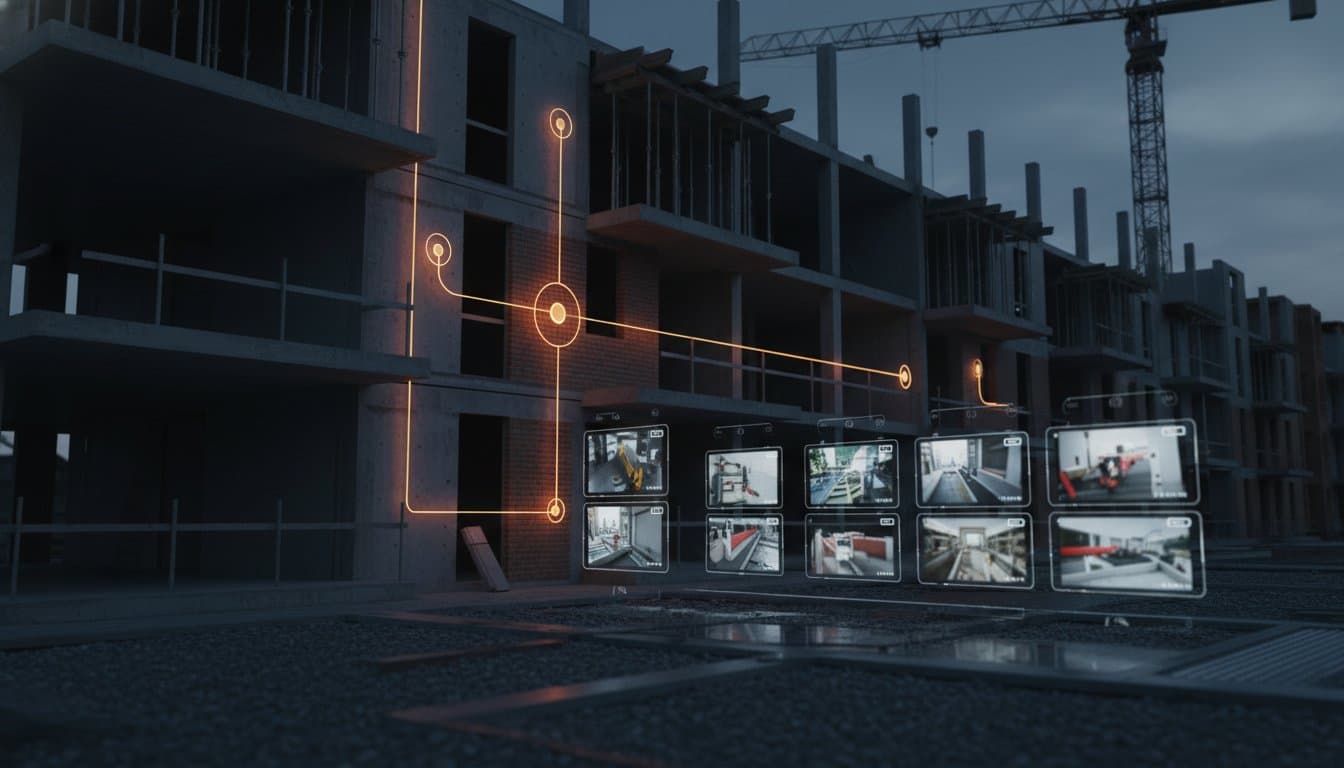
You’re standing in front of a finished wall, knowing the fire-stopping behind it is spot on. But the main contractor won't sign off the payment milestone because you can't prove what's buried. It's a gut-punch. You've done the work. The lads did a proper job. Yet, the money stays in their account while you spend your Saturday scrolling through a messy WhatsApp group looking for one blurry photo. This is the reality of the hidden costs of poor construction quality, where the real price isn't just the physical rework, but the evidentiary failure that halts your cash flow.
We understand the frustration of unpaid invoices and the stress of chasing retentions. With the Building Safety Act 2022 now in full force, the Golden Thread isn't a suggestion. It is a legal requirement that can lead to unlimited fines if you get it wrong. You need a way to protect your business without losing your weekends to admin. Discover how missing site evidence triggers a chain of financial losses and how to protect your retention. We will break down why missing proof causes disputes, the impact of the 2026 material price hikes, and how to ensure your documentation gets you paid faster.
Key Takeaways
- Understand how a single missing photo of buried work triggers a loss chain of held retention and unpaid invoices.
- Identify the hidden costs of poor construction quality and how to avoid the unlimited fines linked to the Building Safety Act.
- Learn how to get the lads to capture the right photos for QA packs without slowing down the job.
- Discover how to move from chaotic phone galleries to an organised work photo library to reclaim your weekends.
- Protect the proof of the work you have already done to ensure you get paid faster on every project.
The Friday afternoon dispute and the true cost of missing proof
You are standing in the rain. Your boots are caked in mud. You are looking at a closed trench whilst the client shakes their head. They won't sign off the drainage run. You know the fall is right. The lads spent all morning getting it spot on. But without a photo of the pipes before the backfill, you are stuck. This is the moment the hidden costs of poor construction quality become a physical reality. It isn't just about the work. It's about the evidentiary failure that stops your cash flow stone dead.
Personal phone galleries are the enemy of your bank balance. When photos are buried in WhatsApp threads or lost on a worker's personal device, they don't exist to the client. There is a massive difference between doing the work and proving the work. One earns you a reputation. The other earns you a payment. Without defensible site records, you are simply hoping the client takes your word for it. In 2026, hope doesn't pay the wages.
Unpaid invoices and the retention trap
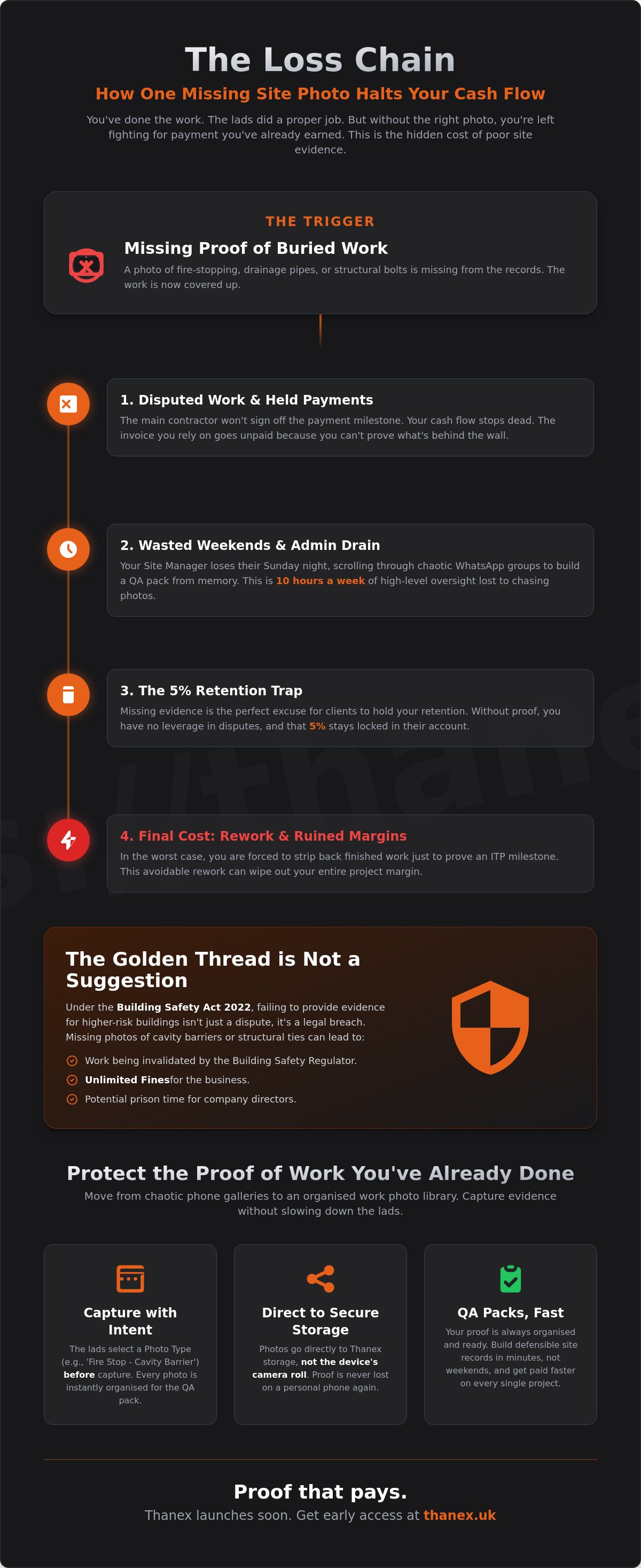
Missing evidence gives clients the perfect excuse to hold your 5% retention. If you lack a photo of a fire-stop or a specific structural bolt, you might be forced to strip back finished cladding just to prove an ITP milestone. The hidden costs of poor construction quality are often found in these avoidable rework sessions. For example, in civil works, failing to prove proper compaction can lead to a reduced pavement lifespan of 30% to 40%. On your site, that same lack of proof leads to held invoices and disputed variations that you simply cannot win.
The admin drain on your senior staff
Think about your Site Manager. They should be managing the lads and keeping the project on track. Instead, they are losing their Sunday nights. They are scrolling through chaotic group chats to find one specific pour date or a reinforcement check. Building a QA pack from memory is a recipe for stress. When your senior staff spend ten hours a week on admin, you aren't just losing time. You are losing the high-level oversight that prevents mistakes in the first place.
Meeting the Golden Thread and avoiding regulatory fines
The Golden Thread isn't just a safety buzzword. It's about your business survival. Since 1 October 2023, the Building Safety Act 2022 has redefined how we document higher-risk buildings. If you're working on structures above 18 metres or 7 storeys, "good enough" is gone. Missing evidence now carries the risk of unlimited fines or even prison time for directors. Generic cloud storage fails the audit test every time. You can't spend three hours searching for a photo whilst an inspector waits. This administrative chaos is one of the biggest hidden costs of poor construction quality.
BSA compliance for masonry and roofing contractors
Masonry and roofing contractors face the toughest scrutiny under the new regime. You need specific, clear photos of every cavity barrier and structural tie before they are closed up. If you can't produce this evidence, the Building Safety Regulator can effectively invalidate the work. This leads to a massive cost of rework that can wipe out your entire project margin. Don't be fooled by apps making absolute "tamper-proof" claims. These often fail to hold up under professional scrutiny. It's better to secure your Golden Thread documentation for Building Safety Act compliance early.
Protecting the proof of the work you have already done
You've done the hard graft. Now you must protect it. Photos should never live on a worker's personal camera roll. They are too easy to lose, impossible to organise, and lack the professional metadata required for a defensible record. By selecting the Photo Type at the moment of capture, you ensure every ITP milestone is documented exactly as required. Images go directly to Thanex storage, not the device gallery. This ensures that the proof of the work you did is ready the moment a client asks for it. You can see how the work camera captures evidence without slowing down the lads on site.
When documentation doesn't meet these standards, you aren't just risking a snag. You are risking the financial stability of the business. The hidden costs of poor construction quality are often found in the gaps where proof should be. Proving your work fast is the only way to stay ahead of the regulations and keep your cash flow moving.
Building a culture of defensible site evidence
The lads on site aren't photographers. They are brickies, sparkies, and joiners. If you ask them to fill out complex forms, they'll stop. If you ask them to scroll through a personal gallery to find a specific bolt, they'll get frustrated. You need a way to capture proof that feels like part of the job, not an extra chore. This shift in culture is the only way to eliminate the hidden costs of poor construction quality. It moves the focus from "doing the work" to "proving the work" without adding a second of downtime.
Transparent reporting builds trust. When you can send a shareable evidence report link to a main contractor, disputes vanish. You aren't just saying the drainage is right. You are showing it. This transparency earns the reputation that brings the next job. It stops the friction between trades and positions your business as the most reliable partner on site. Using clear evidence also speeds up subcontractor payments. When the proof is undeniable, the money moves faster.
Capture work and prove fast
Setting up projects correctly ensures the right evidence is captured every time. By using professional construction evidence features, you create a system where the lads select the work type and snap. That's it. There is no deleting photos to hide mistakes. Instead, photos are invalidated if they aren't right. This creates an honest, defensible audit trail that clients actually respect. It turns a chaotic phone gallery into an organised work photo library that protects the business.
Get paid faster on every project
Connect your site evidence directly to your payment milestones. No more waiting for a site walk-around that keeps getting pushed back. When the client asks for the QA pack, it's already done. You don't lose your Saturday to admin. You get the relief of knowing your cash flow is protected. The hidden costs of poor construction quality often include the interest lost on delayed payments. Stop the delay. Get early access to the work camera and start proving your work as you do it.
Proof that pays.
Thanex launches soon. Get early access at thanex.uk/early-access.
Stop the drain on your site cash flow
The hidden costs of poor construction quality aren't just found in the physical rework. They live in the held invoices, the lost retentions, and the hours you spend scrolling through group chats for a single photo of a cavity barrier. You've done the work. Now you must protect the proof of it. Moving away from chaotic phone galleries ensures every ITP milestone is documented and ready for sign-off the moment it is requested.
Thanex is the work camera designed for UK subcontractors who are tired of losing weekends to admin. It is built for the Building Safety Act, ensuring your site records meet the Golden Thread standards without slowing down the lads. You can get your time back and ensure you get paid faster on every project. It is time to turn your site evidence from a burden into a financial asset that secures your reputation and your cash flow.
Protect your business today and stop the evidentiary failures that halt your progress. You can build the kind of trust that wins repeat work whilst keeping your current projects profitable and your weekends free.
Proof that pays.
Thanex launches soon. Get early access at thanex.uk/early-access.
Frequently Asked Questions
How does the Building Safety Act affect my photo documentation?
The Building Safety Act 2022 turns site documentation into a legal obligation for higher-risk buildings. If you are working on projects over 18 metres or 7 storeys, missing photos of life-safety elements like fire-stopping can lead to unlimited fines. It moves documentation from a "nice to have" to a core requirement for business survival. Failure to comply can stop a project in its tracks and leave you liable for massive delays.
What is the Golden Thread in UK construction?
The Golden Thread is a digital record of a building's entire lifecycle that ensures safety information is accurate and accessible. For subcontractors, this means providing clear, timestamped evidence for every ITP milestone. Without this "single source of truth," you risk held retentions and disputed payments. It's the proof you need to show that the work you did matches the design intent and safety regulations.
Why shouldn’t I use my personal phone for site photos?
Personal phones are where site evidence goes to die. They lack the professional metadata and organisation needed to create a defensible record. Searching through a messy gallery for a specific pour date is one of the hidden costs of poor construction quality that drains your time. When photos live in personal WhatsApp threads, you lose the ability to prove your work fast, leading to unpaid invoices and lost weekends spent on admin.
How do I prove the quality of work that has already been buried?
Proving buried work requires a "capture before cover" approach. You must select the specific Photo Type at the moment of capture so the evidence is linked to the correct job and milestone. If work like drainage or fire-stopping is covered without proof, you face the financial loss of stripping it back just to show the inspector. Having an organised work photo library means you can provide the proof the moment the client asks, protecting your cash flow.
Proof that pays.
Thanex launches soon. Get early access at thanex.uk/early-access.
Disclaimer
The Thanex team builds a work camera for construction.The story is the same on every job. You've finished the work. Someone now wants proof. The photos are on three phones, two group chats, and a laptop you haven't opened in months. The client is waiting. Payment is waiting. So your evening is gone again.Thanex captures proof at the moment of work. Select what the photo is. Take the photo. The details remain with it. Ready when someone asks.The guides on this site are written by people who have been on site, completed QA forms, sent photo reports, and responded to the customer asking for proof before they paid.We write what we have lived. Construction first.
Frequently Asked Questions
Unpaid invoices and the retention trap
Missing evidence gives clients the perfect excuse to hold your 5% retention. If you lack a photo of a fire-stop or a specific structural bolt, you might be forced to strip back finished cladding just to prove an ITP milestone. The hidden costs of poor construction quality are often found in these avoidable rework sessions. For example, in civil works, failing to prove proper compaction can lead to a reduced pavement lifespan of 30% to 40%. On your site, that same lack of proof leads to held invoices and disputed variations that you simply cannot win.
The admin drain on your senior staff
Think about your Site Manager. They should be managing the lads and keeping the project on track. Instead, they are losing their Sunday nights. They are scrolling through chaotic group chats to find one specific pour date or a reinforcement check. Building a QA pack from memory is a recipe for stress. When your senior staff spend ten hours a week on admin, you aren't just losing time. You are losing the high-level oversight that prevents mistakes in the first place. The Golden Thread isn't just a safety buzzword. It's about your business survival. Since 1 October 2023, the Building Safety Act 2022 has redefined how we document higher-risk buildings. If you're working on structures above 18 metres or 7 storeys, "good enough" is gone. Missing evidence now carries the risk of unlimited fines or even prison time for directors. Generic cloud storage fails the audit test every time. You can't spend three hours searching for a photo whilst an inspector waits. This administrative chaos is one of the biggest hidden costs of poor construction quality.
BSA compliance for masonry and roofing contractors
Masonry and roofing contractors face the toughest scrutiny under the new regime. You need specific, clear photos of every cavity barrier and structural tie before they are closed up. If you can't produce this evidence, the Building Safety Regulator can effectively invalidate the work. This leads to a massive cost of rework that can wipe out your entire project margin. Don't be fooled by apps making absolute "tamper-proof" claims. These often fail to hold up under professional scrutiny. It's better to secure your Golden Thread documentation for Building Safety Act compliance early.
Protecting the proof of the work you have already done
You've done the hard graft. Now you must protect it. Photos should never live on a worker's personal camera roll. They are too easy to lose, impossible to organise, and lack the professional metadata required for a defensible record. By selecting the Photo Type at the moment of capture, you ensure every ITP milestone is documented exactly as required. Images go directly to Thanex storage, not the device gallery. This ensures that the proof of the work you did is ready the moment a client asks for it. You can see how the work camera captures evidence without slowing down the lads on site. When documentation doesn't meet these standards, you aren't just risking a snag. You are risking the financial stability of the business. The hidden costs of poor construction quality are often found in the gaps where proof should be. Proving your work fast is the only way to stay ahead of the regulations and keep your cash flow moving. The lads on site aren't photographers. They are brickies, sparkies, and joiners. If you ask them to fill out complex forms, they'll stop. If you ask them to scroll through a personal gallery to find a specific bolt, they'll get frustrated. You need a way to capture proof that feels like part of the job, not an extra chore. This shift in culture is the only way to eliminate the hidden costs of poor construction quality. It moves the focus from "doing the work" to "proving the work" without adding a second of downtime. Transparent reporting builds trust. When you can send a shareable evidence report link to a main contractor, disputes vanish. You aren't just saying the drainage is right. You are showing it. This transparency earns the reputation that brings the next job. It stops the friction between trades and positions your business as the most reliable partner on site. Using clear evidence also speeds up subcontractor payments. When the proof is undeniable, the money moves faster.
Capture work and prove fast
Setting up projects correctly ensures the right evidence is captured every time. By using professional construction evidence features, you create a system where the lads select the work type and snap. That's it. There is no deleting photos to hide mistakes. Instead, photos are invalidated if they aren't right. This creates an honest, defensible audit trail that clients actually respect. It turns a chaotic phone gallery into an organised work photo library that protects the business.
Get paid faster on every project
Connect your site evidence directly to your payment milestones. No more waiting for a site walk-around that keeps getting pushed back. When the client asks for the QA pack, it's already done. You don't lose your Saturday to admin. You get the relief of knowing your cash flow is protected. The hidden costs of poor construction quality often include the interest lost on delayed payments. Stop the delay. Get early access to the work camera and start proving your work as you do it. Proof that pays.Thanex launches soon. Get early access at thanex.uk/early-access. The hidden costs of poor construction quality aren't just found in the physical rework. They live in the held invoices, the lost retentions, and the hours you spend scrolling through group chats for a single photo of a cavity barrier. You've done the work. Now you must protect the proof of it. Moving away from chaotic phone galleries ensures every ITP milestone is documented and ready for sign-off the moment it is requested. Thanex is the work camera designed for UK subcontractors who are tired of losing weekends to admin. It is built for the Building Safety Act, ensuring your site records meet the Golden Thread standards without slowing down the lads. You can get your time back and ensure you get paid faster on every project. It is time to turn your site evidence from a burden into a financial asset that secures your reputation and your cash flow. Protect your business today and stop the evidentiary failures that halt your progress. You can build the kind of trust that wins repeat work whilst keeping your current projects profitable and your weekends free. Proof that pays.Thanex launches soon. Get early access at thanex.uk/early-access.
How does the Building Safety Act affect my photo documentation?
The Building Safety Act 2022 turns site documentation into a legal obligation for higher-risk buildings. If you are working on projects over 18 metres or 7 storeys, missing photos of life-safety elements like fire-stopping can lead to unlimited fines. It moves documentation from a "nice to have" to a core requirement for business survival. Failure to comply can stop a project in its tracks and leave you liable for massive delays.
What is the Golden Thread in UK construction?
The Golden Thread is a digital record of a building's entire lifecycle that ensures safety information is accurate and accessible. For subcontractors, this means providing clear, timestamped evidence for every ITP milestone. Without this "single source of truth," you risk held retentions and disputed payments. It's the proof you need to show that the work you did matches the design intent and safety regulations.
Why shouldn’t I use my personal phone for site photos?
Personal phones are where site evidence goes to die. They lack the professional metadata and organisation needed to create a defensible record. Searching through a messy gallery for a specific pour date is one of the hidden costs of poor construction quality that drains your time. When photos live in personal WhatsApp threads, you lose the ability to prove your work fast, leading to unpaid invoices and lost weekends spent on admin.
How do I prove the quality of work that has already been buried?
Proving buried work requires a "capture before cover" approach. You must select the specific Photo Type at the moment of capture so the evidence is linked to the correct job and milestone. If work like drainage or fire-stopping is covered without proof, you face the financial loss of stripping it back just to show the inspector. Having an organised work photo library means you can provide the proof the moment the client asks, protecting your cash flow. Proof that pays.Thanex launches soon. Get early access at thanex.uk/early-access.