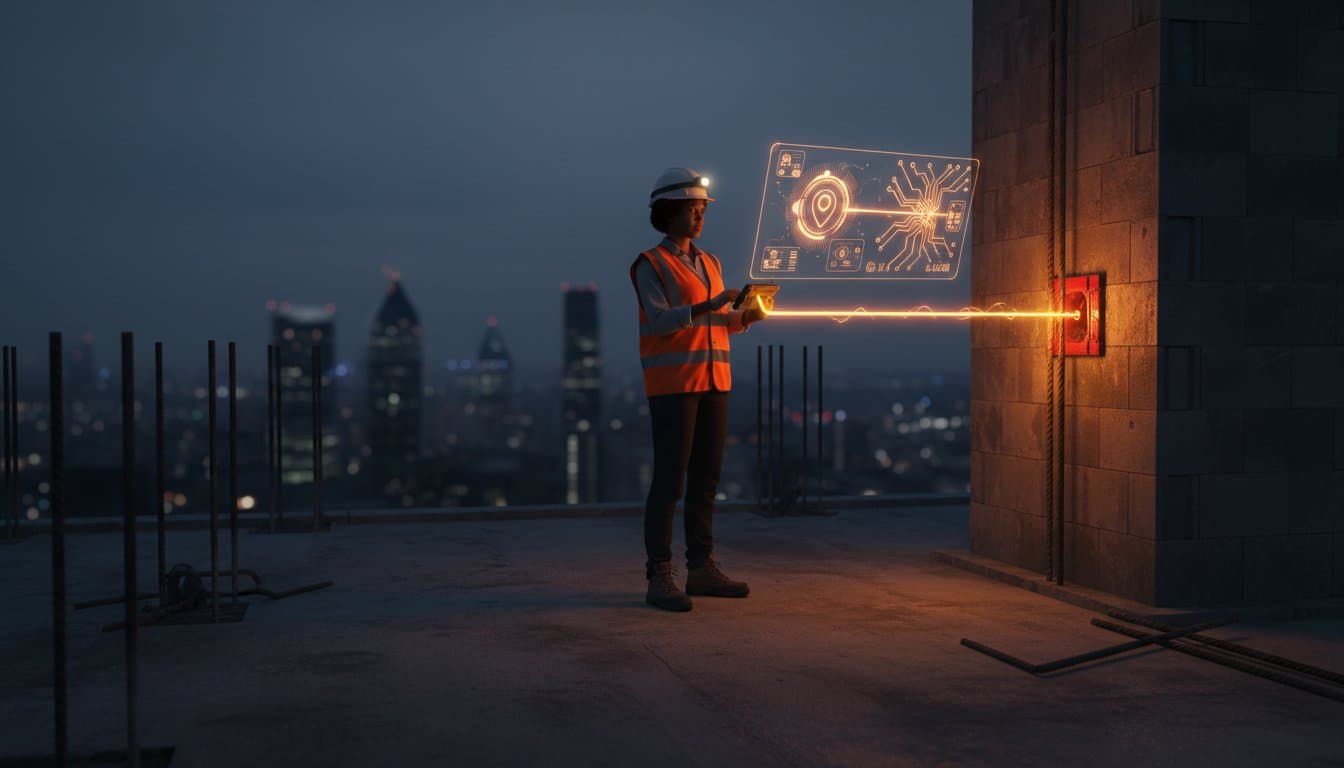
It is Sunday night. You are scrolling through a WhatsApp group with 200 unread messages. You need one photo of a dpc installation to release a £3,000 payment milestone. Without proper geotagging photos on construction sites, that image is impossible to find. Your invoice stays unpaid, and your evening is gone.
You know the work is finished. You know the quality is there. But does a blurry photo with no context satisfy a Building Safety Act audit? Probably not. A photo without data is just a file, not proof.
You will learn how to use geotagged evidence to meet Golden Thread standards, secure your retention, and stop losing your weekends to admin. As the work camera designed to capture work and prove fast, we show you how selecting a Photo Type at the moment of capture creates a clear, defensible history of every job.
Proof that pays.
Thanex launches soon. Get early access at thanex.uk/early-access.
Key Takeaways
- Learn why GPS coordinates are essential for the Golden Thread and Building Safety Act compliance on high-rise projects.
- Stop losing Sunday nights to the WhatsApp scroll by avoiding phone galleries that strip away your location data.
- Use geotagging photos on construction sites to prove your work was done right and release held retention.
- Discover how selecting a Photo Type before you capture ensures your QA pack is ready for audit without extra admin.
- Protect your cash flow by linking every photo to a specific trade and location before you leave the site.
Why geotagging photos is now non-negotiable for UK building safety
You stand in front of a completed fire-stop. You take a quick snap on your personal phone and move on. Six months later, the Building Safety Regulator asks for proof that this specific seal meets the design. Your photo has no location data. The wall is now closed up. You are looking at a £5,000 strip-out just to prove you did the job right. The cost of a single missing coordinate is your entire profit margin on the floor.
Geotagging is the process of embedding GPS coordinates into a photo file to prove exactly where on-site the work happened. Implementing geotagging photos on construction sites turns a simple image into defensible evidence. Without it, your records are just digital clutter. Missing or faked location data leads to rejected QA packs and held retention payments. You cannot afford to guess where a photo was taken when the building's safety is on the line.
The Golden Thread and your bottom line
The Building Safety Act 2022 made the Golden Thread a legal duty. This digital record must be accurate and up to date. If you cannot produce a geotagged photo during an audit, you might be forced to re-do work that was already perfect. The cost of "the lads" taking random snaps on WhatsApp is too high. Professional documentation protects your profit. It ensures your site QA photo evidence is ready when the main contractor asks for it. Intentional capture is always better than auto-tagging because it proves the worker was focused on the specific ITP or snag.
Meeting the 18 metre and 7 storey threshold
Regulations are strictest for higher-risk buildings. These are residential blocks over 18 metres or 7 storeys. On these projects, every photo must link to a specific floor level and zone for as-built records. Geotagging provides the horizontal coordinates, but selecting a "Photo Type" before you shoot ensures the vertical context is captured. This level of detail is what gets your payment milestones signed off. It moves you from chaos to control. Accurate evidence stops the cycle of unpaid invoices and secures your reputation for the next job.
The cost of a messy gallery: Why personal phones fail the Golden Thread
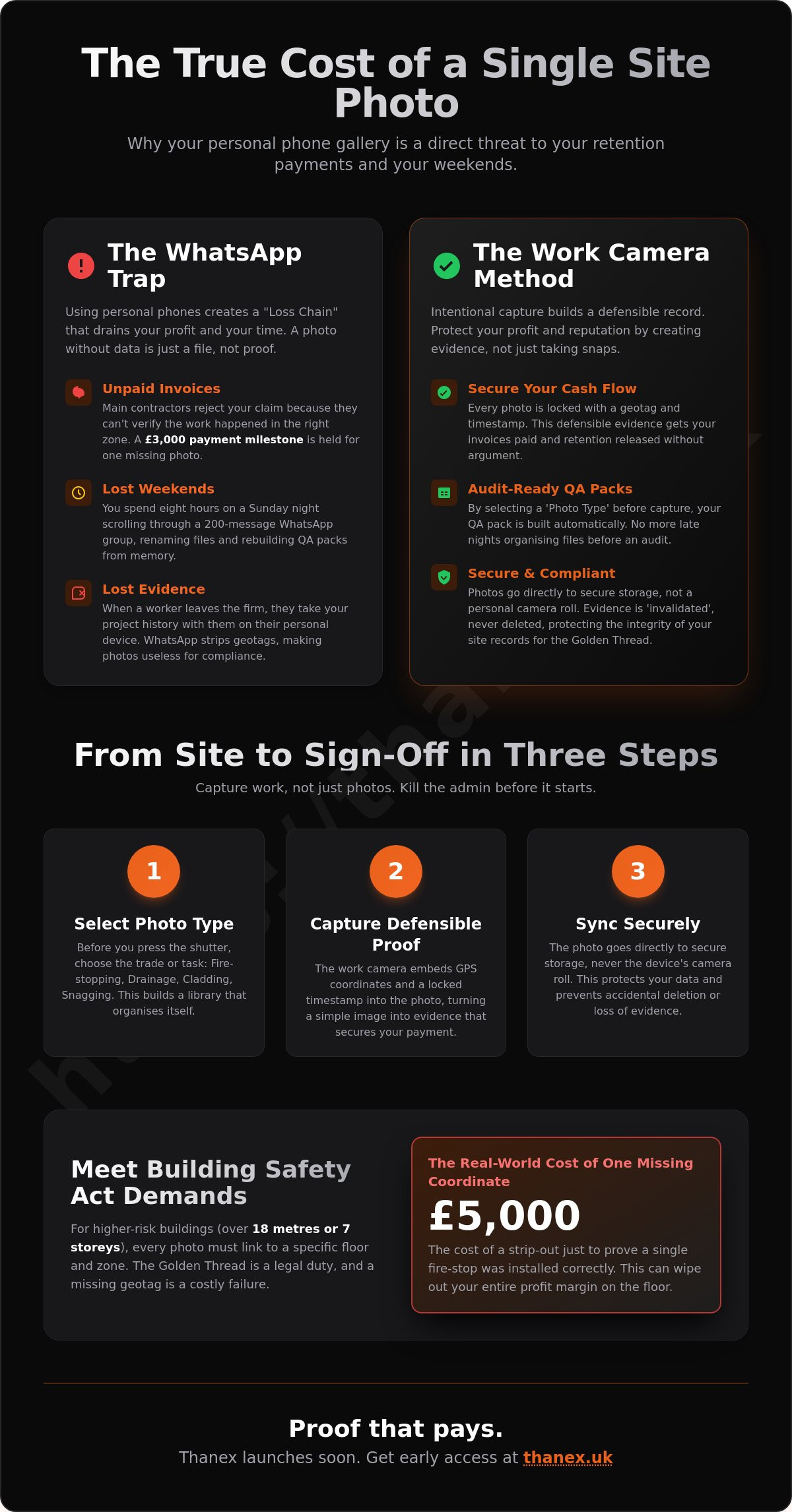
You are scrolling. It's late on a Sunday. You need one photo to prove the cavity trays went in. It is lost in a sea of personal snaps, holiday selfies, and half-eaten kebabs. This is the "old-you" cost. It isn't just messy. It is expensive. A disorganised gallery is a direct threat to your retention and your peace of mind.
Standard phone galleries aren't built for compliance. When you send a photo over WhatsApp or iMessage, the app often strips the metadata to save file space. The location data vanishes. This makes geotagging photos on construction sites impossible to maintain through a simple group chat. If you cannot verify the location, you cannot satisfy the golden thread requirements. You also risk a GDPR nightmare by mixing your private life with professional liability.
The Loss Chain of the personal camera roll
- Unpaid invoices: Main contractors reject your payment claim because they cannot verify the work happened in the right zone.
- Lost weekends: You spend eight hours on a Sunday renaming files and rebuilding QA packs from memory.
- Disputed dates: Without a locked timestamp, you cannot prove that a concrete pour happened before the rain started.
- Lost evidence: When a worker leaves the firm, they take your project history with them on their personal device.
Professional work cameras vs standard apps
A dedicated work camera is the only way to keep site records secure. Site photos must go directly to secure storage, never the device's camera roll. This prevents accidental deletion or loss. In a professional system, photos are invalidated rather than deleted. This protects the integrity of your site records. It ensures that every shutter press is a permanent part of the project's history. You don't just take a photo. You build a defensible record that ensures you get paid for every hour worked.
How to organise geotagged evidence without losing your weekends
You finish the snagging. Instead of just clicking a button, you select the trade. Fire-stopping. Drainage. Cladding. By choosing the Photo Type before you press the shutter, you kill the admin before it starts. This is how you master geotagging photos on construction sites. You aren't just taking pictures. You are building a library that organises itself. You move from the site to the next job without a second thought about paperwork.
Visibility wins work. Use shareable evidence report links to give main contractors what they need before they even ask. It stops the constant chasing for updates. When your records are this clean, you build a reputation for bulletproof documentation. Top-tier firms want contractors they can trust. They want the firm that has the proof ready on day one. It makes you the preferred choice for the next big contract.
Proof that pays: Using metadata to get paid faster
A defensible QA pack is your best tool for cash flow. When you use GPS and timestamps to prove progress, main contractors have nothing to dispute. You meet your payment milestones because the proof is undeniable. This Build UK guide highlights how vital these records are for the modern site. Professional geotagging photos on construction sites ensures that every image is a financial asset rather than a digital burden. You can learn more about our photo evidence app to see how we lock these details in.
The new-you change: From chaos to control
Imagine finding one specific fire-seal photo from three months ago in four seconds. That is the power of a searchable library that works with your AI assistant. No more scrolling through the lads' WhatsApp messages. No more guessing which floor you were on. You protect your business from future claims with immutable site records that stay exactly where you put them. See how Thanex helps with construction projects by turning your field work into a permanent asset. You get your weekends back. Your retention is secure.
Proof that pays.
Thanex launches soon. Get early access at thanex.uk/early-access.
Secure your retention and your weekends
Your work is high quality. Your evidence should be too. Relying on a messy camera roll is a risk to your cash flow and your time. You've seen how geotagging photos on construction sites meets the strict standards of the Building Safety Act. It turns a simple image into a defensible asset for the Golden Thread. No more guessing. No more disputes.
Stop scrolling through personal snaps to find one specific fire-stop. Move your site records to secure storage outside the camera roll. By selecting a Photo Type before you shoot, you build a QA pack that main contractors cannot ignore. It's the difference between an unpaid invoice and a closed-out job. You've done the hard graft. Now make sure you have the proof to back it up.
Protect your reputation and your profit. Capture Work. Prove Fast. with a tool designed specifically for the UK industry. It's time to move from administrative chaos to professional control. Get home on time and leave the paperwork on the site.
Proof that pays.
Thanex launches soon. Get early access at thanex.uk/early-access.
Frequently Asked Questions
Is a standard iPhone photo enough for Building Safety Act compliance?
A standard iPhone photo is often insufficient for strict Building Safety Act audits. Metadata like GPS coordinates is frequently stripped when the lads share images via messaging apps. Without selecting a Photo Type at the moment of capture, your records lack the trade context required for the Golden Thread. You risk a rejected QA pack and a costly strip-out just to prove compliance.
What happens if a worker deletes a site photo from their phone?
If a worker deletes a photo from a personal gallery, that evidence is gone for good. Professional systems ensure photos are invalidated rather than deleted to protect the integrity of your site records. Images go directly to secure storage instead of the local camera roll. This prevents the loss of critical proof when a worker leaves the firm or clears their device storage.
How do geotagged photos help with payment disputes?
Geotagging photos on construction sites provides the location data needed to prove progress against specific payment milestones. It stops arguments about whether a job was completed in the correct zone or floor. When you present a defensible QA pack with locked timestamps, main contractors have no reason to hold your retention. You get paid for the work you've already done without the Sunday night admin.
Can I use geotagged photos for snagging and defect management?
You can use geotagged records to link every snag directly to a precise location on the site. This makes defect management faster because the lads know exactly where to go. Organising your snagging photos by trade ensures that as-built records are ready for handover. It prevents the cycle of repeated snags and ensures you meet your project deadlines without chasing missed ITPs.
Proof that pays.
Thanex launches soon. Get early access at thanex.uk/early-access.
Disclaimer
The Thanex team builds a work camera for construction. The story is the same on every job. You've finished the work. Someone now wants proof. The photos are on three phones, two group chats, and a laptop you haven't opened in months. The client is waiting. Payment is waiting. So your evening is gone again. Thanex captures proof at the moment of work. Pick what the photo is. Take the photo. The details stay with it. Ready when someone asks. The guides on this site are written by people who have been on site, completed QA forms, sent photo reports, and answered the customer asking for proof before they paid. We write what we have lived. Construction first.
Frequently Asked Questions
The Golden Thread and your bottom line
The Building Safety Act 2022 made the Golden Thread a legal duty. This digital record must be accurate and up to date. If you cannot produce a geotagged photo during an audit, you might be forced to re-do work that was already perfect. The cost of "the lads" taking random snaps on WhatsApp is too high. Professional documentation protects your profit. It ensures your site QA photo evidence is ready when the main contractor asks for it. Intentional capture is always better than auto-tagging because it proves the worker was focused on the specific ITP or snag.
Meeting the 18 metre and 7 storey threshold
Regulations are strictest for higher-risk buildings. These are residential blocks over 18 metres or 7 storeys. On these projects, every photo must link to a specific floor level and zone for as-built records. Geotagging provides the horizontal coordinates, but selecting a "Photo Type" before you shoot ensures the vertical context is captured. This level of detail is what gets your payment milestones signed off. It moves you from chaos to control. Accurate evidence stops the cycle of unpaid invoices and secures your reputation for the next job. You are scrolling. It's late on a Sunday. You need one photo to prove the cavity trays went in. It is lost in a sea of personal snaps, holiday selfies, and half-eaten kebabs. This is the "old-you" cost. It isn't just messy. It is expensive. A disorganised gallery is a direct threat to your retention and your peace of mind. Standard phone galleries aren't built for compliance. When you send a photo over WhatsApp or iMessage, the app often strips the metadata to save file space. The location data vanishes. This makes geotagging photos on construction sites impossible to maintain through a simple group chat. If you cannot verify the location, you cannot satisfy the golden thread requirements. You also risk a GDPR nightmare by mixing your private life with professional liability.
The Loss Chain of the personal camera roll
Unpaid invoices: Main contractors reject your payment claim because they cannot verify the work happened in the right zone. Lost weekends: You spend eight hours on a Sunday renaming files and rebuilding QA packs from memory. Disputed dates: Without a locked timestamp, you cannot prove that a concrete pour happened before the rain started. Lost evidence: When a worker leaves the firm, they take your project history with them on their personal device.
Professional work cameras vs standard apps
A dedicated work camera is the only way to keep site records secure. Site photos must go directly to secure storage, never the device's camera roll. This prevents accidental deletion or loss. In a professional system, photos are invalidated rather than deleted. This protects the integrity of your site records. It ensures that every shutter press is a permanent part of the project's history. You don't just take a photo. You build a defensible record that ensures you get paid for every hour worked. You finish the snagging. Instead of just clicking a button, you select the trade. Fire-stopping. Drainage. Cladding. By choosing the Photo Type before you press the shutter, you kill the admin before it starts. This is how you master geotagging photos on construction sites. You aren't just taking pictures. You are building a library that organises itself. You move from the site to the next job without a second thought about paperwork. Visibility wins work. Use shareable evidence report links to give main contractors what they need before they even ask. It stops the constant chasing for updates. When your records are this clean, you build a reputation for bulletproof documentation. Top-tier firms want contractors they can trust. They want the firm that has the proof ready on day one. It makes you the preferred choice for the next big contract.
Proof that pays: Using metadata to get paid faster
A defensible QA pack is your best tool for cash flow. When you use GPS and timestamps to prove progress, main contractors have nothing to dispute. You meet your payment milestones because the proof is undeniable. This Build UK guide highlights how vital these records are for the modern site. Professional geotagging photos on construction sites ensures that every image is a financial asset rather than a digital burden. You can learn more about our photo evidence app to see how we lock these details in.
The new-you change: From chaos to control
Imagine finding one specific fire-seal photo from three months ago in four seconds. That is the power of a searchable library that works with your AI assistant. No more scrolling through the lads' WhatsApp messages. No more guessing which floor you were on. You protect your business from future claims with immutable site records that stay exactly where you put them. See how Thanex helps with construction projects by turning your field work into a permanent asset. You get your weekends back. Your retention is secure. Proof that pays.Thanex launches soon. Get early access at thanex.uk/early-access. Your work is high quality. Your evidence should be too. Relying on a messy camera roll is a risk to your cash flow and your time. You've seen how geotagging photos on construction sites meets the strict standards of the Building Safety Act. It turns a simple image into a defensible asset for the Golden Thread. No more guessing. No more disputes. Stop scrolling through personal snaps to find one specific fire-stop. Move your site records to secure storage outside the camera roll. By selecting a Photo Type before you shoot, you build a QA pack that main contractors cannot ignore. It's the difference between an unpaid invoice and a closed-out job. You've done the hard graft. Now make sure you have the proof to back it up. Protect your reputation and your profit. Capture Work. Prove Fast. with a tool designed specifically for the UK industry. It's time to move from administrative chaos to professional control. Get home on time and leave the paperwork on the site. Proof that pays.Thanex launches soon. Get early access at thanex.uk/early-access.
Is a standard iPhone photo enough for Building Safety Act compliance?
A standard iPhone photo is often insufficient for strict Building Safety Act audits. Metadata like GPS coordinates is frequently stripped when the lads share images via messaging apps. Without selecting a Photo Type at the moment of capture, your records lack the trade context required for the Golden Thread. You risk a rejected QA pack and a costly strip-out just to prove compliance.
What happens if a worker deletes a site photo from their phone?
If a worker deletes a photo from a personal gallery, that evidence is gone for good. Professional systems ensure photos are invalidated rather than deleted to protect the integrity of your site records. Images go directly to secure storage instead of the local camera roll. This prevents the loss of critical proof when a worker leaves the firm or clears their device storage.
How do geotagged photos help with payment disputes?
Geotagging photos on construction sites provides the location data needed to prove progress against specific payment milestones. It stops arguments about whether a job was completed in the correct zone or floor. When you present a defensible QA pack with locked timestamps, main contractors have no reason to hold your retention. You get paid for the work you've already done without the Sunday night admin.
Can I use geotagged photos for snagging and defect management?
You can use geotagged records to link every snag directly to a precise location on the site. This makes defect management faster because the lads know exactly where to go. Organising your snagging photos by trade ensures that as-built records are ready for handover. It prevents the cycle of repeated snags and ensures you meet your project deadlines without chasing missed ITPs. Proof that pays.Thanex launches soon. Get early access at thanex.uk/early-access.